Most packing lists for the Manaslu Circuit Trek are written for a generic international trekker. They assume unlimited outdoor gear budgets, access to specialist shops, and familiarity with kit that many UK travellers simply do not own yet.
This guide is different. It is written specifically for British trekkers — people who shop at Cotswold Outdoor and Decathlon, fly from Heathrow or Leeds Bradford, and want a straight answer about what actually goes in the bag for 14 days on one of Nepal’s most spectacular trekking circuits.
The Manaslu Circuit is a serious trek. It climbs from subtropical jungle at 700 metres to the Larkya La Pass at 5,160 metres — a range that demands kit for tropical humidity and sub-zero wind within the same two-week trip. Getting the packing right before you leave home makes every day on the trail easier.
Here is exactly what UK trekkers need — and what they can leave behind.
Before We Talk Kit — The Weight Rule
Your main duffel bag goes with your porter. That bag should weigh no more than 10 kg. Your day pack — which you carry yourself for 6 to 8 hours daily — should sit between 5 and 8 kg maximum.
Every single item on this list should be justified against those limits. I will flag the non-negotiables clearly. Everything else is personal choice within your weight allowance.
If you are booking a Manaslu Circuit Trek Package through a reputable operator, a sleeping bag, down jacket, and duffle bag are often provided — confirm this before you buy or rent anything in Kathmandu. It saves both money and weight.
Clothing — The Layering System That Actually Works
The Manaslu Circuit is a layering challenge, not a single-temperature problem. Think of it in three zones.
Lower Gorge (Days 1–4, up to 2,000m): Hot, humid, jungle trails. You will sweat through a t-shirt within an hour. The same kit you would pack for a warm summer holiday in Europe works here.
Mid-altitude (Days 5–8, 2,000–4,000m): Cool mornings, warm afternoons, cold evenings. This is where your layering earns its keep.
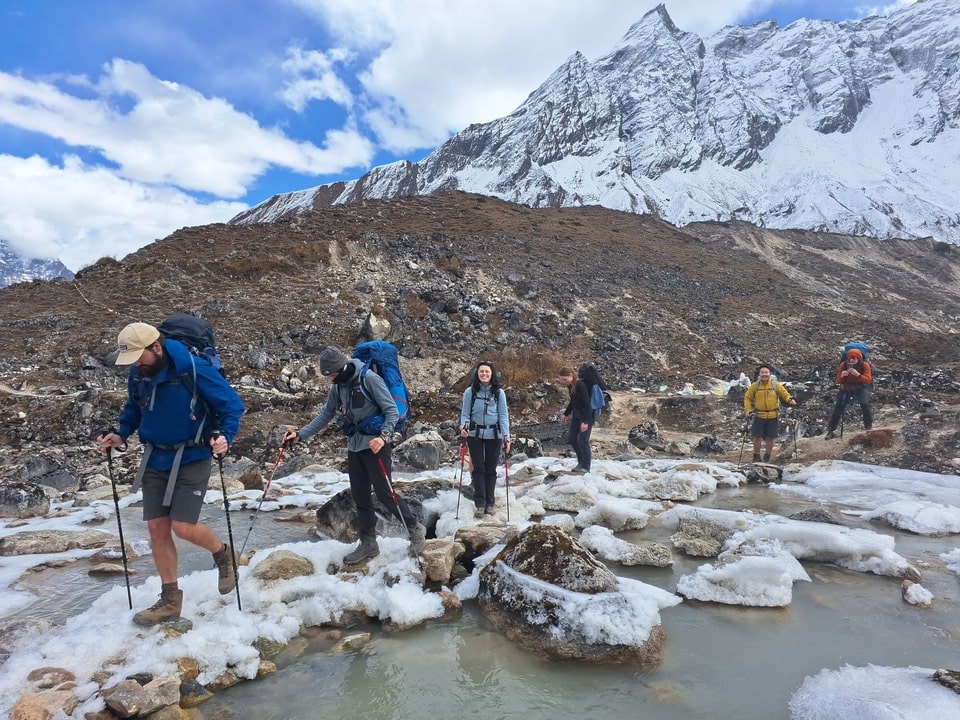
High altitude (Days 9–11, above 4,000m including the Larkya La): Cold. Genuinely cold. Pre-dawn starts in temperatures that can hit -15°C with wind chill on the pass.
Base Layers
2 x merino wool long-sleeve tops — not cotton, not a standard gym top. Merino wicks sweat, resists odour over multiple days (important when showers stop above Namrung), and works in both warm and cold conditions. Icebreaker and Smartwool are both excellent and widely available from UK outdoor retailers like Snow and Rock or Cotswold Outdoor.
1 x lightweight merino for warm days — a short-sleeve or thin long-sleeve for the lower gorge section.
1 x merino base layer leggings — for the Larkya La crossing day and cold nights above 4,000m.
2 x trekking trousers — zip-off convertibles are ideal for the lower gorge. Avoid denim absolutely. Decathlon’s trekking range offers excellent value if you are kitting out on a budget.
Mid Layers
1 x midweight fleece — your daily workhorse above Jagat. Polartec 200 weight is the standard. Worn from morning start, often removed by mid-morning, back on by late afternoon. Regatta and Berghaus both do reliable options without breaking the bank.
1 x down or synthetic insulated jacket — this is your second mid-layer reserved for high camp, rest stops above 4,000m, and the Larkya La crossing. If your package includes one, great — if not, rent one in Kathmandu’s Thamel district for around £2–3 per day rather than buying new.
Outer Shell
1 x hardshell waterproof jacket — GORE-TEX or equivalent. Wind on Larkya La is real and biting. Your shell blocks it. A standard UK walking waterproof from Blacks or Mountain Warehouse will do the job if it is a proper hardshell — not a fashion rain jacket.
1 x shell trousers — most people forget these. Your legs are exposed on the Larkya La descent for four hours and wind chill on an open slope at 5,000m is brutal. Lightweight ones that pack into their own pocket add almost no weight.
Accessories
Warm hat and balaclava — the balaclava is not optional for the Larkya La. Wind gets behind a standard beanie and chills your neck rapidly.
2 x gloves — one lightweight liner pair for general use above 3,500m, one warm waterproof pair specifically for the pass. Wet gloves at altitude are a cold injury risk.
Neck gaiter — lighter than a balaclava for the mid-altitude sections.
Sun hat — for afternoon trekking in the lower sections.
3 x merino wool trekking socks — rotate daily above Samagaon. Darn Tough are worth the price. Bring a second pair to rotate and your feet will thank you.
Footwear
Trekking boots — mid or high cut, waterproof, broken in. This is the single most important piece of kit and the one most people get wrong. Your boots must be properly broken in — minimum 50 km of walking before you fly. Blisters on day three of a 14-day trek in a remote gorge are not a minor inconvenience.
For the Larkya La, your boots need to be stiff enough to hold microspikes securely. Scarpa, Salomon, and Merrell all make excellent options at different price points. Try them at Cotswold Outdoor or a specialist walking shop — never buy boots untested online for a trek like this.
Camp sandals or light trainers — for evenings at the teahouse. Your feet need a rest from boots. A pair of lightweight Crocs or flip flops weighs almost nothing.
Gaiters — short ankle gaiters are useful in the muddy lower gorge and on the snow near Larkya La. Not essential but genuinely helpful.
Sleeping and Comfort
Sleeping bag rated to -10°C — teahouse blankets above Samagaon are inadequate on cold nights. If your package includes a sleeping bag, confirm the temperature rating before departure. If you are renting in Kathmandu, specify -10°C minimum.
Sleeping bag liner — adds 3–5°C of warmth for minimal weight and doubles as a sheet on warm lower-altitude nights.
Earplugs — teahouses are communal. Other trekkers, thin walls, dogs in the early hours. Pack them.
Eye mask — sunrise in the Himalayas is early and teahouse curtains are thin.
Hydration and Water
Reusable water bottle (1 litre minimum) — the Manaslu circuit has safe water stations in some villages charging approximately 50 Nepali rupees per litre. Bring a stainless steel or hard plastic BPA-free bottle.
Water purification tablets or UV pen (SteriPen) — for sections between water stations and for the pre-dawn Larkya La start when stations are closed. Iodine tablets weigh nothing and are available at any UK outdoor shop.
Electrolyte tablets — you sweat more than you think at altitude even in cold weather. Hydration salts (High5 or SiS available from most UK sports retailers) help prevent the dehydration that accelerates altitude sickness.
Medical and First Aid
Your operator’s guide should carry a group first aid kit and a pulse oximeter. This is your personal kit — small, light, and specific.
Altitude medicine: Ask your GP about Acetazolamide (Diamox) before you travel. Not everyone uses it, but having a prescription gives you options. Your GP can advise on dosage and side effects.
Ibuprofen and paracetamol — for headaches at altitude. Do not mask symptoms without also monitoring your oxygen saturation.
Imodium and rehydration sachets — stomach bugs are the most common non-altitude health issue on Nepal treks. Be prepared.
Blister kit — Compeed blister plasters are worth their weight in gold on day four.
Sun cream SPF50+ — UV radiation increases significantly above 4,000m and reflects off snow. This is not optional.
Lip balm with SPF — your lips will crack at altitude without it.
Hand sanitiser — teahouses do not always have soap.
Personal prescription medication — take double your required amount in two separate bags.
Electronics
Headtorch with spare batteries — the Larkya La crossing starts at 3–4 AM. This is a hard non-negotiable. Petzl and Black Diamond both make excellent lightweight options. Cold kills batteries fast — keep spares warm in an inner pocket.
Portable power bank — phone charging is available at teahouses for a small fee (100–200 NPR typically) but availability becomes unreliable above Samagaon. A 10,000 mAh bank covers 3–4 phone charges.
Universal travel adaptor — Nepal uses Type C and Type D sockets. A small adaptor weighing 50g solves all charging issues in Kathmandu.
Camera or phone — the Manaslu Circuit is extraordinarily photogenic. Whatever you normally use is fine. Protect it from dust in the gorge and cold above 4,000m.
Offline maps downloaded — download Maps.me or AllTrails maps for the Manaslu Circuit offline before you leave Kathmandu. Mobile signal is inconsistent above Namrung.
Documents and Money
Travel insurance certificate (printed and digital) — travel insurance is mandatory for Nepal trekking permits and must cover helicopter evacuation to at least 5,500m. World Nomads and Battleface both offer policies specifically covering high-altitude trekking. Do not skip this — a helicopter evacuation without insurance can cost £8,000–£15,000.
Passport copy (2 copies) — one in your day pack, one in your main duffel.
US dollars in cash — Nepal’s teahouse economy runs on cash above the lower villages. Bring USD 200–300 in small bills for drinks, tips, and incidentals. Exchange to Nepali rupees in Kathmandu.
Emergency contact card — laminated, in your day pack. Include your operator’s 24-hour emergency number, your travel insurer’s emergency line, and your next of kin contact.
What to Leave at Home
Cotton anything. Jeans, cotton t-shirts, hoodies. Cotton holds moisture against your skin and chills you rapidly at altitude. Leave all of it in Kathmandu.
A full-size towel. Teahouses provide towels on request or you adapt. A microfibre travel towel weighing 100g is all you need.
Guidebooks. Your guide knows more than any printed book. Download what you need digitally.
More than two pairs of trekking trousers. You will wear the same pair for days at altitude. That is normal.
Fancy restaurants for Kathmandu. Pack one decent shirt or smart casual top for your two Kathmandu nights. One. Not four.
What to Buy or Rent in Kathmandu
Thamel district in Kathmandu has excellent outdoor gear shops with both genuine brands and high-quality replica kits at a fraction of UK prices.
Rent: Sleeping bag, down jacket, trekking poles, microspikes. Rental costs approximately £2–5 per item per day.
Buy affordably: Buff neck gaiters, trekking socks, base layers, sun cream, water purification tablets, snacks for the trail.
Do not buy in Kathmandu: Boots. A 2-day Kathmandu stay provides no opportunity to break in new footwear. Boots must arrive from the UK already broken in.
This same kit list applies almost identically to shorter Nepal treks. Trekkers who want to test their gear and altitude tolerance before committing to 14 days on the Manaslu Circuit often start with the Langtang Valley Trek — a 7-day route using the same layering system, the same boots, and the same day pack setup, at a maximum altitude of 3,870 metres. Everything bought or rented for Langtang transfers directly to Manaslu on a future trip.
The Larkya La Crossing Day — The Kit That Matters Most
Day 9 of the standard Manaslu Circuit is the day your kit gets its real test. You leave Dharmasala at 3–4 AM in darkness and temperatures that can be -15°C with wind. Here is exactly what goes on your body for that day, in order:
- Merino base layer top and leggings
- Midweight fleece
- Down jacket
- Hardshell jacket over everything
- Shell trousers over leggings
- Warm hat and balaclava
- Waterproof gloves
- Headtorch on
By mid-climb you will remove the down jacket. At the summit, it goes back on immediately. On the descent, it comes off again after 30 minutes. This is layering in practice — not elegant, but effective.
Conclusion
The Manaslu Circuit covers 177 kilometres of extraordinary Himalayan terrain across 14 days. The packing list does not need to be expensive or exhaustive — it needs to be correct. The right base layers, a properly broken-in pair of boots, a reliable hardshell, and a headtorch for the Larkya La will carry any trekker through the full circuit comfortably.
The Manaslu Circuit Trek Package from Magical Nepal includes a sleeping bag, down jacket, and duffle bag as standard — removing three of the most significant packing decisions from the list entirely and keeping the overall kit weight manageable from day one.