England is famous for its architectural, historical and cultural attractions, but when it comes to natural wonders, many of us think first of neighbouring Scotland and Wales rather than England. In our opinion, this is undeserved: there are many exceptionally expressive natural monuments in good old England.
The Seven Sisters
This is a ridge of seven chalk cliffs stretching along the coast of the Dover Strait (East Sussex). They were once part of a so-called dry valley, a special coastal formation, but over time the sea eroded it, turning the hills into jagged cliffs overlooking the water’s edge. Their most striking feature is their colour. Due to their chalk origin, the cliffs are dazzlingly white, glistening slightly in the sun. It was because of their unusual colour that the Romans, who came here across the English Channel two thousand years ago, named these lands Albion (from the Latin albus, meaning ‘white’). The hills are covered with grass and flowers, and sheep roam in the valleys between them — almost nothing has changed since the days of the Roman Empire.
It is literally impossible to take your eyes off the landscape: snow-white hills, turquoise water, lighthouses, seagulls — and each view is more beautiful than the last. The evening is a special time: the rocks reflect the light, giving the twilight an extraordinary expressiveness. Many nature lovers come here specifically in the evening, rather than during the day, to watch the sunset and, when it gets dark, to admire the stars.
The Seven Sisters cliffs are part of the South Downs National Park, and there are walking trails of varying difficulty nearby. The whole family can go for a walk here, including children.
And we have something wonderful for you — the best selection of exciting games — play online roulette at Las Atlantis
There is also another famous chalk cliff complex — the White Cliffs of Dover in neighbouring Kent, but those cliffs are more covered with greenery and the colour is not as bright.
Winnet’s Pass
This pass was formed millions of years ago when a crust of water-eroded limestone collapsed over a huge underground cave, which apparently once contained a glacier. The rift was flooded with seawater, turning the crack into a lagoon. Later, the water receded, leaving a dry bed enriched with the remains of marine animals and pieces of shells, and the wind completed the job, turning the rift into a picturesque canyon.
Winnaught Pass has a gloomy beauty, thanks to which many legends have sprung up around it. According to one of them, the gorge appeared when the devil himself blew in the direction of the local mountains. We are not sure about the devil, but the landscapes here are truly impressive.
If you reach the village of Castleton, it is also worth visiting the caves. There are four of them, and they are all a combination of natural gullies and the remains of 18th-century lead mines. The mines were flooded many years ago, so the underground labyrinth can only be accessed by boat tour, which can be booked in the village. The caves feature stalactites and stalagmites, waterfalls, underground lakes and sinkholes, the deepest of which is called ‘The Abyss’ — in ancient times, people believed that it led to hell.
Cheddar Gorge
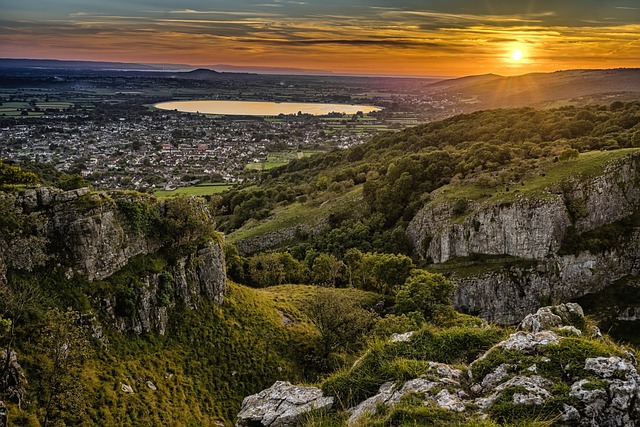
When talking about the local canyons, one cannot miss Cheddar Gorge, the largest in Britain.
It cuts through the Mendip Hills — a complex of chalk hills in Somerset. The canyon was formed millions of years ago by water flowing down from melting glaciers. Nowadays, the B3135 road runs along its bottom.
It climbs quite steeply, but allows you to see the walls of the canyon — the gentle northern wall and the almost vertical southern wall. The light-coloured rock here is covered with lush greenery, and small animals run around and birds fly overhead. If you climb the staircase carved into the rock, known by locals as Jacob’s Ladder (after the biblical story), you can walk along the footpath at the top of the hill.
The staircase is high and steep, but it is worth climbing because the views from the top are incredibly beautiful. After visiting here, Tolkien came up with the idea for Helm’s Deep in The Lord of the Rings — he talked about this at Inklings meetings. The view is truly breathtaking!