Visit York estimates 8.88 million people visited the city in 2025, and the city deserves every one of them. Most were day visitors, in and out within hours, and even many of the 1.87 million who stayed longer never got past the walls. The Minster, a ghost walk, a fudge shop and the train home make up the standard run, while the county the city takes its name from often misses out on even an afternoon.
Yorkshire proper starts about ten minutes beyond the ring road, where hedges give out to drystone and the lanes shrink to a tractor’s width. From there on, the thing that decides the day is what you happen to be travelling in, since a coach and a four-seat car won’t see remotely the same county.
The Yorkshire That Never Makes the Brochure
North-west of the city lie the Dales. Expect green valleys, field barns, waterfalls with real force behind them after rain (Aysgarth Falls gets genuinely loud) and the Ribblehead Viaduct, 24 arches of Victorian stone marching over a moor that looks untouched since the railway men packed up. The Moors pull the other way, purple with heather from August into September, with villages like Hutton-le-Hole tucked into the folds, where sheep graze the green between the cottages.
Rievaulx, Byland, Jervaulx, Fountains: before the Reformation ripped through them, these were among the richest and most powerful monasteries in England, and their ruins can still silence a chatty group within a minute of walking in. Rievaulx proves the point best. Turn up on a weekday morning and you’ll often share one of England’s finest ruins with more jackdaws than people.
Where a Fifty-Seater Rarely Goes
Coach routes get planned backwards: parking first. A full-size vehicle needs a marked drop-off bay, a turning circle, toilets close at hand and somewhere to idle for a couple of hours, which is why the same honeypot stops appear on every set-route day trip sold out of York. Appletreewick, a two-pub Wharfedale village reached down a lane barely wider than a tractor, is almost never a stop on conventional coach itineraries. The back road over Blakey Ridge is likely to miss out too, along with the lay-by that holds the clearest view of the Kilburn White Horse carved into its hillside.
So millions of visitors tick Yorkshire off each year without touching the corners locals are proudest of, because so much of the county’s finest scenery waits at the end of roads that larger vehicles tend to leave alone. No PA commentary makes up for that. Hearing a guide describe Blakey Ridge through a speaker while the coach stays on the A-road is a poor swap for standing on it.
Days That Bend Around the Weather
Fixed routes have another problem: they can’t adapt halfway through the day. Four seasons before lunch counts as standard practice for the local weather, so a set-timetable day will park forty people in front of rain-streaked windows at the very stop the schedule sold as the highlight. Smaller groups dodge the problem entirely. When the moor turns soggy a sheltered abbey steps in, and a misty start simply becomes the reason the coast gets saved for the afternoon.
That sort of mid-morning rethink only happens when the group is small enough to agree on it. That flexibility is one of the reasons Highwayman Tours keeps things deliberately small. One private car, no strangers, and a day that can adapt around the people in it, the weather and whatever proves most interesting along the way, whether that means lingering a little longer in a village the group has taken to or pulling over at an unmarked castle ruin spotted from the road. Boring stops get dropped without ceremony. The whole day ends up bending around whatever the people in the car find interesting.
Then comes the question of lunch. Pubs across the county take their food seriously, and the best hours of a day out are usually the unplanned long ones, when the fire’s going, the Theakston’s has been poured, the pudding menu appears and nobody checks a watch. No coach will idle while a table debates sticky toffee pudding, but a guide with one carload of guests will happily wait.
The Long Way into Whitby
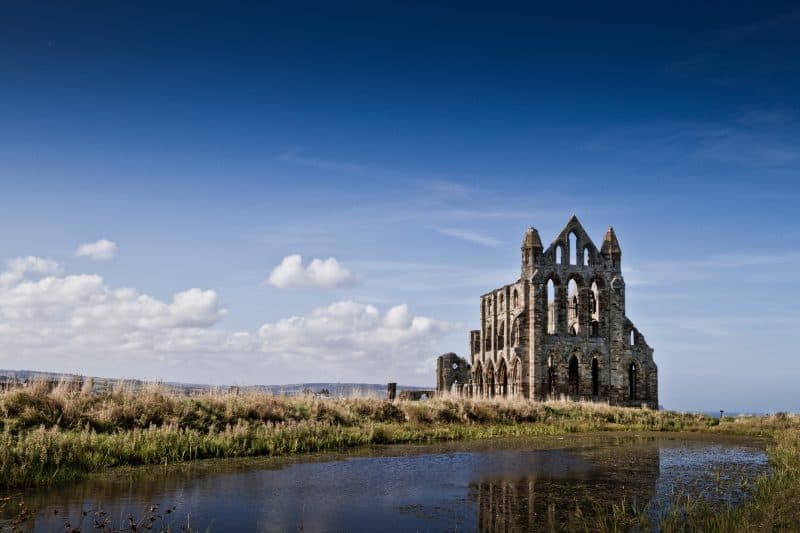
One drive can settle the whole argument. Take the moor crossing towards the coast and the farmland falls away behind you, the horizon empties of everything except heather and sky, and then Whitby appears far below with the abbey black against the East Cliff and the harbour curled around the mouth of the Esk.
Bram Stoker stayed in Whitby in 1890 and drew on the town heavily for Dracula, from the abbey ruins to the churchyard where Lucy meets the Count. More than a century on, the town still earns the drama, from the 199 steps up to St Mary’s churchyard to the Captain Cook monument on the West Cliff opposite, where a whalebone arch has stood in one form or another for over 170 years. The most recent pair of bones, put up in 2003, came down in 2026, with a bronze replica planned to take their place.
Robin Hood’s Bay waits ten minutes further down the coast, an old smuggling village packed so steeply into its ravine that everyone leaves the car at the top and walks down through the ginnels. Nobody ends up there by accident, either. Reaching the coast this way, with time spared for both towns and a moorland village somewhere on the route, belongs in a different category from filing out of a coach park to somebody else’s timetable.
Yorkshire Is a County Best Taken Slowly
Anyone planning a spring visit should set aside at least one full day for the far side of the walls. Spring is when the county looks its best: lambs in every Dales field, waterfalls still fat with winter rain, and villages getting on with life before the summer crowds arrive. Rooms and tour dates go early too. Whoever books soonest will get the widest pick of both, plus the quiet corners of the county largely to themselves.
York has earned every one of those 8.88 million visitors, and nobody should skip the Minster out of principle. The wider county just wants slower attention. Travellers who swap the fixed route for a small car and an open-ended day will head home with stories most of those millions never get close to.