Updated November 2026
“Police approved” is one of the most reassuring phrases in a front door brochure, and one of the least understood. Secured by Design is a real and demanding scheme, run on behalf of the UK police, and a door that genuinely carries it has been attacked in a test rig, certified by an independent body and made in a factory that is inspected every year. But approval belongs to a specific doorset in a specific build. A door can be “available with” Secured by Design and still arrive without it, because the glass, the letterplate or the cylinder on your order is not the one that was approved.
So the useful question is not just whether a brand offers police approval, but whether it comes as standard, on request, or as a paid upgrade, and how to check you got it. This guide explains what the scheme covers, how burglars attack a front door and which part resists each attack, the cylinder marks that matter, and how six brands handle approval, from Latham’s Steel Doors, which includes it on its security doors, to makers that sell it as a named upgrade.
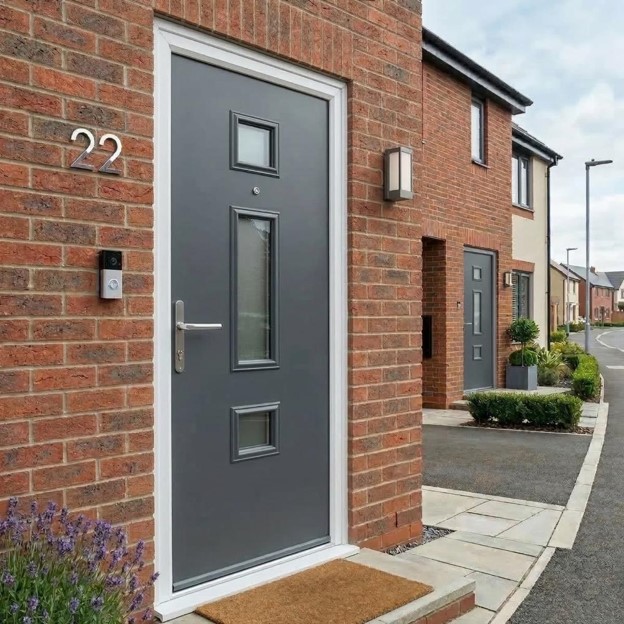
A steel front door in anthracite grey. Image: Latham’s Steel Doors
What Secured by Design is, and what it is not
Secured by Design operates an accreditation scheme on behalf of the police for products that meet recognised security standards. Accredited products carry what the scheme calls Police Preferred Specification. For that, a product must be independently tested to a relevant standard and certified by a third party accredited by UKAS, or by an approved body such as Sold Secure. It must then be re-tested regularly, and the factory that makes it is inspected every year.
That last part is what separates approval from a one-off test result. A test proves one sample survived; Secured by Design vouches for the production line. The scheme also cites its own evidence: on two Nottingham City Homes estates covering 1,520 properties, burglary fell by 42% after Secured by Design windows were fitted, against 21% across the city.
For front doors, the test behind the approval is usually PAS 24, applied to the complete doorset: the frame, the leaf, the locks, the hinges and any glazing together. Door-Stop describes part of what that involves: on top of the security testing, a 30 kg ball is swung into the door in nine different places to check it will stand up to a shoulder barge.
What approval is not is a legal requirement. Approved Document Q, the security part of the Building Regulations in England, applies only to new homes. On an existing house, choosing an approved door is your decision.
How a front door is attacked, and what resists it
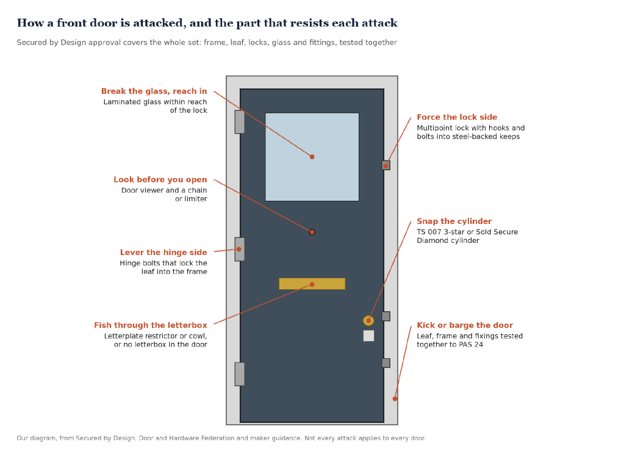
Our diagram.
Burglars rarely do anything subtle. The common attacks on a front door are physical and quick: snapping the cylinder, levering the door at the lock or hinge side, kicking or barging it, breaking glass to reach a thumbturn, or “fishing” through the letterbox for keys or the handle. Each has a specific defence, and an approved doorset has all of them working together.
This is why the small parts matter. The leaf and lock get the attention, but a door with a superb lock and an open letterplate can still be opened with a hooked wire. Everest states that to gain Secured by Design accreditation, a door with a letterbox must have a fishing guard fitted. Hurst lists the parts its approval upgrade adds: a security cowl on the letterplate, a safety chain, a spyhole, laminated glass if the door is glazed and a cylinder with a guard. Solidor’s published specification goes further, covering an inward-opening door, slimline hinges and a restricted letterplate in the middle position.
Anti-snap cylinders: read the face of the cylinder
Cylinder snapping, breaking the barrel the key turns in and then working the lock, is the attack most associated with older uPVC doors. The Door and Hardware Federation recognises three ways to reach the protection level that resists it:
| Route | What to look for | Watch out for |
| TS 007 3-star cylinder | The Kitemark and three stars together on the cylinder face | “Anti-snap” printed on packaging is not a rating |
| TS 007 1-star cylinder with a 2-star handle | A Kitemarked 1-star cylinder plus a Kitemarked 2-star armoured handle or surround | Swap the handle for an unrated one and the protection goes |
| Sold Secure Diamond | The Sold Secure Diamond mark (SS312) | Lower Sold Secure grades are not equivalent |
Some cylinders carry both a TS 007 3-star Kitemark and Sold Secure Diamond. Either on its own meets the bar, and the Door and Hardware Federation notes that Diamond cylinders are Secured by Design approved.
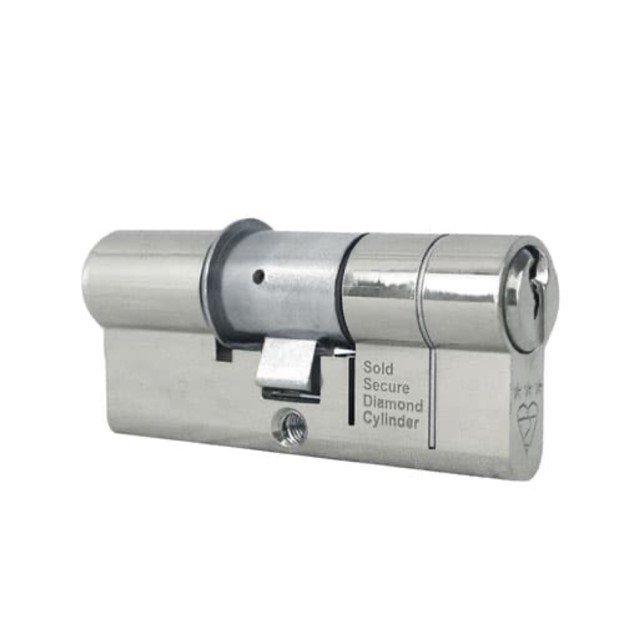
A three-star Kitemarked cylinder: the marks are stamped on the face. Image: Latham’s Steel Doors
Secured by Design front doors: six brands, from standard to upgrade
Brands handle approval in three ways: included on the doors they sell, available on request, or sold as a named upgrade package. None is wrong, but the second and third leave more to check on the order.
| Brand | How approval is offered | Worth knowing |
| Latham’s Steel Doors | Best for police approval as standard | Each security door listed as Secured by Design and PAS 24 tested |
| Everest | Standard on PAS 24 doors | Letterbox fishing guard is an optional extra |
| Rockdoor | Available on every door | First to achieve it for French and double doors |
| Solidor | To a published specification | The specification lists every part |
| Door-Stop | Upgrade package with certificate | Ultion cylinder on every door |
| Hurst | Upgrade with a named parts list | A useful checklist for any brand |
1. Latham’s Steel Doors: best for police approval as standard
Latham’s Steel Doors lists its High Security, 6 Panel and Cottage Style front doors and its Security Back Door as Secured by Design certified and tested to PAS 24, so there is nothing to add at the order stage. Each has a Winkhaus multipoint lock, 3-star Kitemarked cylinders and triple hinge dog bolts that hold the galvanised steel leaf into a steel-reinforced frame, and the cylinders come with an anti-burglary guarantee. Each door is made to measure.
2. Everest: approval across uPVC, composite and aluminium
Everest says its doors pass PAS 24:2022 and carry Secured by Design approval, with a 3-star cylinder offering anti-snap, anti-pick, anti-bump and anti-drill protection. The exceptions are its stable doors and timber entrance doors, which have a 1-star cylinder. Letterbox fishing guards and door chains are optional extras, and since a door with a letterbox needs a fishing guard for approval, put it on the quote.
3. Rockdoor: approval on every door, including French doors
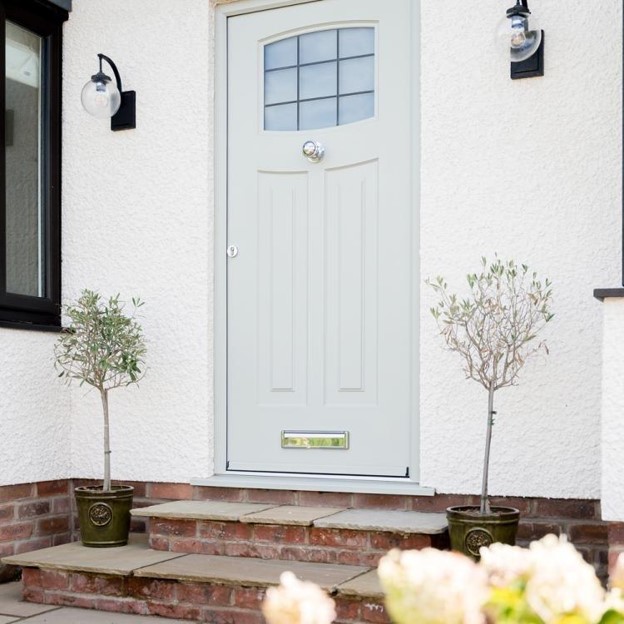
Newark composite door in agate grey. Image: Rockdoor
Every Rockdoor is available with Secured by Design, and Rockdoor says it was the first in the industry to achieve the accreditation for French and double doors. Its doors use TS 007 3-star cylinders, and hinges, glazing and locking straps are fixed straight into a continuous aluminium box section around the door. Ask for approval when you are quoted, because “available with” means it must be specified.
4. Solidor: approval to a published specification
Solidor fits 3-star cylinders and publishes the specification an approved door must meet: an inward-opening door, laminated glass, slimline hinges, a restricted letterplate in the middle position, an Ultion cylinder, a door guard and a spyhole unless there is clear glass nearby. Every item can be ticked off a quote, which makes Solidor’s list useful even to buyers comparing other brands.
5. Door-Stop: an upgrade package with a certificate
Door-Stop fits an Ultion lock to every door, designed to detect an attack and switch into Lockdown Mode, with a security guarantee of up to £5,000. Secured by Design is an accredited upgrade package, and an approved door can be ordered with a certificate as proof, which helps if an insurer or letting agent asks what is fitted.
6. Hurst: an upgrade with a named parts list
Hurst’s doors are tested to PAS 24, and its Secured by Design upgrade names exactly what it adds: a security cowl for the letterplate, a safety chain, a spyhole, laminated glass on glazed doors and a cylinder with a guard. Hurst notes that many insurers offer discounts for approved doors. Price the upgrade with the door so you compare like with like.
Check you got what you paid for
Four checks before you pay the balance:
- Search the scheme’s product list. The Secured by Design website lists accredited products by member company. Look for the product by its exact name, because approval belongs to the product.
- Get approval written on the order. It should name the door style, glazing, letterplate and cylinder, and the standard it was tested to.
- Compare the delivered door with the approved build. Letterplate position and restrictor, glass, viewer, chain and opening direction should all match.
- Read the cylinder face. Photograph the Kitemark and stars, or the Diamond mark, and keep it with your paperwork and any guarantee registration.
Check the fitted door against the approved specification before the fitter leaves. Illustrative image.
FAQs
Is Secured by Design the same as PAS 24?
No. PAS 24 is a test standard for the doorset. Secured by Design is the police accreditation that requires a product to pass a recognised test such as PAS 24, be certified by an independent body, and be made in a factory that is inspected every year.
Is Secured by Design a legal requirement for a replacement front door?
No. Approved Document Q, which deals with security, applies only to new homes in England. On an existing home it is your choice, though many insurers and letting agents look for it.
Is a 3-star cylinder the same as Sold Secure Diamond?
They are different ratings that reach the same level of protection against snapping, picking and drilling. The Door and Hardware Federation recognises both, and some cylinders carry both marks.
Can I make my existing door Secured by Design?
Not formally, because approval belongs to a doorset certified as a whole. You can close most of the gap by fitting a 3-star or Diamond cylinder, a letterplate restrictor, a chain and a viewer.
Does a Secured by Design door lower home insurance?
It can. Some insurers offer discounts for approved doors, and having the certificate makes it easy to answer an insurer’s questions about what is fitted. Ask your insurer before you buy.